
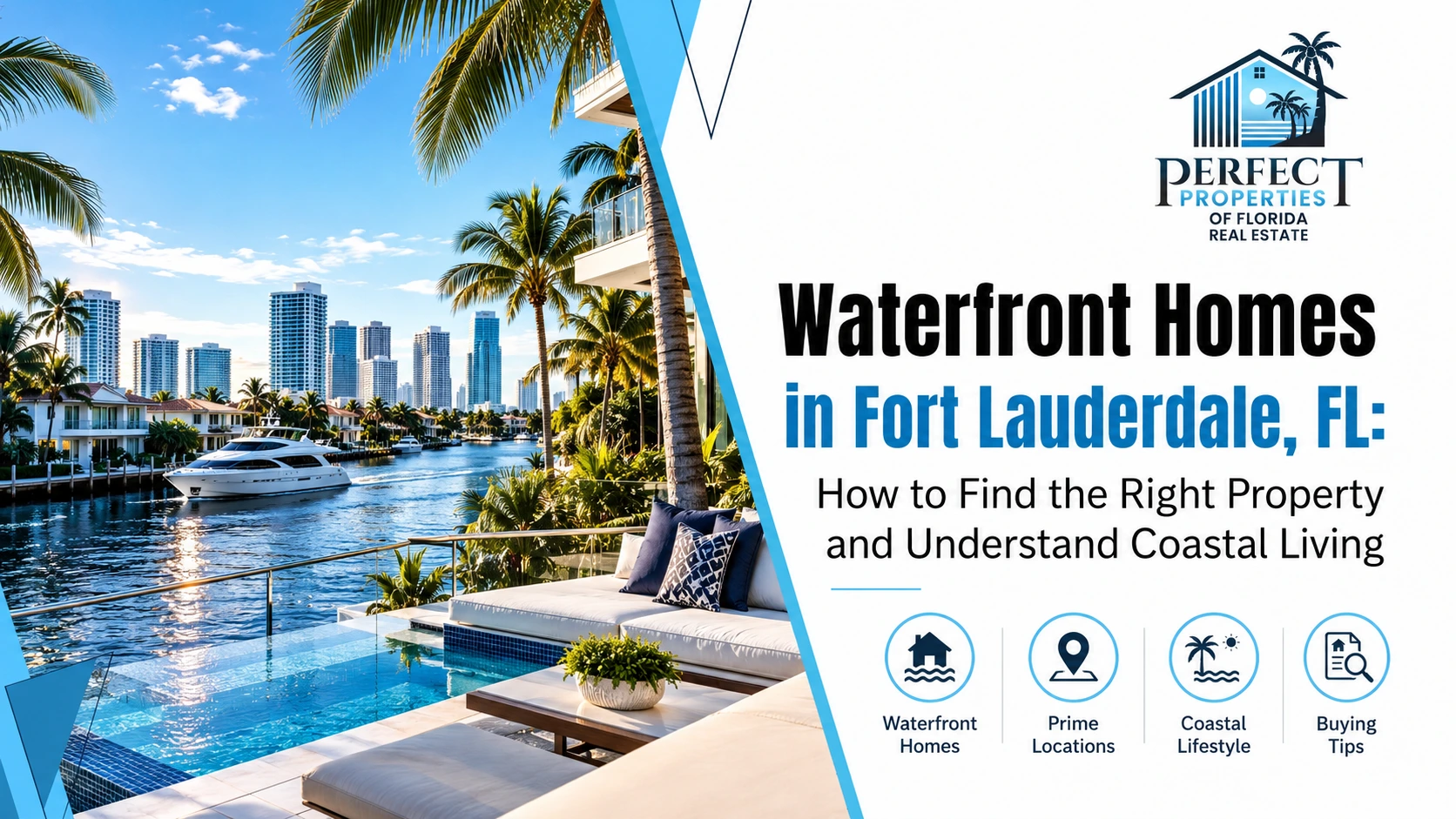
Fort Lauderdale has roughly 165 miles of navigable waterways inside the city and about 300 miles across the greater area. That is why people call it the “Venice of America.” It also means “waterfront” covers a very wide range of properties. Two homes with the same view can differ by hundreds of thousands of dollars, and by whether you can actually take your boat to the ocean.
This guide covers what buyers need to know about waterfront homes in Fort Lauderdale, FL: the property types, how to choose among them, what they really cost, how flood and hurricane risk work, and what to inspect before you close.
Quick Takeaways
- Not all waterfront is equal. Water depth, bridge clearance, and seawall condition matter more than the view.
- The highest hidden cost is often the seawall. Replacement can run into six figures.
- Flood insurance, windstorm coverage, and a seawall inspection should be on your list before you make an offer, not after.
- Boat length is rarely the limiting factor. Boat height and draft usually are.
- Waterfront homes carry a clear price premium, but that is not a guaranteed return.
What Are the Benefits of Buying a Waterfront Home in Fort Lauderdale?
The obvious benefit is lifestyle. You get water views, breezes, sunsets, and in many neighborhoods, a dock steps from your back door. If you boat, you can leave from home instead of paying for a marina slip and driving to it.
There are practical benefits too:
- Scarcity. Waterfront lots are finite. Nobody is making more canal frontage, which is part of why these homes hold a price premium.
- Boating convenience. A private dock means no trailer, no ramp lines, and no wet-slip fees, if the access works for your boat.
- Location. Many waterfront neighborhoods sit close to Las Olas Boulevard, the beaches, downtown, and the airport.
- Florida’s tax picture. Florida has no state income tax, which is a reason many buyers relocate here. Your property tax situation is separate, and we cover it below.
Be realistic about the trade-offs. Salt air is hard on everything, and you take on seawall, dock, and insurance responsibilities that inland owners never see.
What Types of Waterfront Properties Are Available in Fort Lauderdale?
Most listings fall into a few categories:
- Canal homes. The most common type. They sit on residential canals that feed into the Intracoastal Waterway or the New River.
- Intracoastal homes. These sit directly on the main waterway. They have wider water, bigger views, and more boat traffic.
- Oceanfront and beach-area properties. Often condos or high-rise buildings, with a smaller number of single-family homes on the barrier island.
- River properties. Homes along the New River have a different feel, with historic neighborhoods and working marinas nearby.
- Waterfront condos and townhomes. Often the most accessible entry point. Check the association’s finances and reserve planning carefully, especially in older coastal buildings.
- Waterfront lots and tear-downs. Popular with buyers who want to build new, but they bring permitting and seawall requirements of their own.
How to Choose Between Canal-Front, Intracoastal, and Ocean-Access Homes
Start with how you will actually use the water. A kayak paddler and a 50-foot yacht owner need completely different properties.
| Option | Best For | Main Benefit | Important Consideration |
| Canal-front on a fixed-bridge canal | Boaters with smaller, lower-profile boats | Often more affordable than deep-water access | Fixed bridges cap your boat height permanently |
| Canal-front with no fixed bridges | Owners of larger boats, sailboats, sportfish | Unrestricted route to the Intracoastal and ocean | Higher price; confirm depth and any drawbridge schedules |
| Intracoastal-front | Buyers who want wide-open water and views | Direct access to the main waterway | More wake and boat traffic; wind and water exposure |
| Oceanfront or beach-area | Buyers focused on beach lifestyle | Ocean views and sand access | Salt exposure, stricter coastal rules, usually higher insurance |
“Ocean-access” is one of the most misunderstood phrases in a listing. It can mean a clean route with no fixed bridges, or it can mean a long trip through a no-wake zone, under a drawbridge with a posted schedule. Ask exactly what the route looks like, then verify it yourself by boat if you can.
Factors that should drive your choice:
- The height, draft, and length of your boat (or the boat you plan to buy).
- How often you will actually use it.
- Whether you want a quiet cul-de-sac or an active waterway.
- Your tolerance for maintenance and insurance costs.
- Resale appeal. Deep-water, no-fixed-bridge access tends to widen your future buyer pool.
What Boat Owners Should Know About Waterfront Homes With Private Docks
A private dock is not automatically a usable one. Before you fall for a property, work through these four questions.
1. What is the height limit between this dock and open water?
Fixed bridges don’t open. Many residential canal bridges in Fort Lauderdale are commonly cited at around 14 to 17 feet of clearance at mean high water, which blocks sailboats, tall towers, and most flybridge boats. By contrast, bridges on the main Intracoastal channel are described as having 65 feet of clearance, with a few exceptions. The 17th Street Causeway bridge is reported at roughly 55 feet above mean high water.
Walk or boat the entire route. One low bridge anywhere along the way sets the ceiling for every boat using that dock.
2. Is there enough water?
Draft (how deep your boat sits) matters at low tide. Ask for recent depth soundings at the dock and along the canal, because canals can silt up over time. If the listing says “deep water,” ask what that means in feet at mean low water.
3. Does the dock fit your boat and the canal?
Check the dock’s length and condition, the pilings, the cleats, the lift, and how much room you have to turn. A big boat on a narrow canal can be tough to maneuver, and neighbors’ boats count too.
4. What do the rules allow?
Docks, seawalls, and bulkheads in Broward County generally require environmental approvals. The County publishes technical guidance on its general license requirements for docks, seawalls, and bulkheads, and the City’s dock permit checklist calls for County approval and engineer-sealed plans for the dock and piles. If you plan to add a dock, lift, or larger structure, confirm what is permitted before you buy, not after.
A simple way to evaluate dock access, step by step:
- Write down your boat’s height, draft, and length.
- Ask the listing agent for the exact route to the Intracoastal.
- List every bridge on that route and its posted clearance.
- Check depth at the dock and along the canal at low tide.
- Confirm that existing permits cover the dock, lift, and any other structures.
- Ask a marine surveyor or local boater to verify.
How Much Do Waterfront Homes Cost in Fort Lauderdale, FL?
Prices vary widely by neighborhood, water type, and lot size, and the market shifts, so treat any figure as a starting point and ask for current comparable sales.
The waterfront premium is real. In Douglas Elliman’s Q3 2025 report, waterfront single-family homes in Fort Lauderdale averaged about $3.05 million, against roughly $1.22 million for single-family homes citywide. Medians told a similar story, at about $1.91 million versus $650,000.
Some broker market commentary puts the starting point for deep-water canal homes at around $1.5 million, with large deep-water estates reaching well into eight figures. Fixed-bridge canals and waterfront condos generally sit below that.
Asking price and sale price can also diverge. One 2026 market review found Fort Lauderdale homes selling about 6% below list on average, so ask your agent what comparable homes actually closed for. These figures come from brokerage and market-report sources, so confirm current numbers before relying on them.
What Additional Costs Should Waterfront Homeowners Budget For?
The purchase price is only the beginning. Waterfront ownership adds a layer of costs that inland buyers do not face.
| Recent contractor guidance puts full replacement at roughly $1,500 to $3,500 or more per linear foot, with targeted repairs far lower. | |
| Get quotes before you commit. | |
| Flood insurance | Required if you have a federally backed mortgage in a high-risk zone, and wise even where it isn’t. |
| Homestead protections apply only if the home is your primary residence. Confirm with the Broward County Property Appraiser. | |
Seawalls deserve special attention. Fort Lauderdale’s current standard for new or rebuilt seawalls is 5.0 feet NAVD88, and a repair that affects more than half the wall’s length can trigger the requirement to bring the whole wall up to current standards. In practice, a wall that looks “mostly fine” can turn into a full replacement the moment a permitted repair crosses that threshold. A standard 80 to 100 linear foot lot can run from $120,000 to $250,000 for a replacement, and that estimate is not unusual for this market. Confirm current numbers with a licensed marine contractor.
How Do Flood Zones, Hurricane Risks, and Insurance Affect Waterfront Properties?
These three issues are linked, and they affect both your monthly costs and your ability to finance the home.
Flood zones
FEMA flood maps assign each property a zone, and your lender uses that zone to decide whether flood insurance is mandatory. Elevation also matters. A home built above the base flood elevation is in a better position than one at street level. Ask for an elevation certificate, which documents exactly where the home sits relative to flood levels.
Flood pricing under FEMA’s Risk Rating 2.0 is based on individual property factors, not just the zone. For existing policies, increases are capped at 18% per year, but new policyholders pay the full calculated price right away. Don’t assume the seller’s current premium will carry over to you.
Florida also strengthened seller disclosure. Under a law that took effect October 1, 2025, sellers of residential property must disclose any known flood damage during their ownership and whether they received flood-related assistance from any source. Read that disclosure carefully and ask follow-up questions.
Hurricane risk
The hurricane season runs June 1 to November 30. Waterfront homes face wind and surge exposure, so construction quality matters. Look at the roof age, window and door protection, and whether the home was built to a recent Florida Building Code. Many insurers ask for a wind mitigation report, and older homes may also need a 4-point inspection.
Insurance
Windstorm and flood coverage are separate policies. Standard homeowners insurance doesn’t cover flood damage. Get quotes for both before you remove your contingencies, because a surprise premium can change your whole budget. An independent insurance agent who writes coastal Florida policies can compare carriers for you.
What Should Buyers Check Before Purchasing a Waterfront Property?
Once a property passes the lifestyle test, a few things deserve a hard look before you even write an offer:
- Water access. Bridge clearances, depth, and the route to the Intracoastal.
- Seawall age and condition. Ask for any past inspection reports and permit history.
- Flood zone and elevation. Request the elevation certificate.
- Insurance availability and cost. Get real quotes.
- Deed and ownership of water rights. Make sure the property includes the access you think it does.
- Neighborhood rules. Some communities or associations have dock, boat size, or rental restrictions.
- Noise and traffic. Visit at different times of day, including weekends.
What Inspections and Documents Should You Review Before Closing?
Inspections
Documents
- Seller’s flood disclosure and any disclosures about past claims
- Permit history for the seawall, dock, additions, and renovations
- Title work and survey
- Insurance claim history (a CLUE report, where available)
- HOA or condo documents, including budgets, reserve information, and special assessments
- Recent tax bills and an estimate of how they may change after the sale
Close attention to the paperwork can save you from an expensive surprise, such as unpermitted dock work or a seawall that is due for replacement.
Is Buying a Waterfront Property in Fort Lauderdale a Good Long-Term Investment?
It can be, but it isn’t automatic. The case for it is straightforward: limited supply, steady demand from people who want the lifestyle, and a premium for homes with usable water access. Those traits have supported values in the past.
The case for caution is just as clear. Waterfront homes carry higher insurance costs, seawall obligations, and storm exposure. Even Douglas Elliman’s market analysis stresses that strong recent numbers don’t, on their own, prove a long-term pattern.
A few practical points help you judge:
- Homes with true deep-water, no-fixed-bridge access usually appeal to a broader group of future buyers.
- A seawall already built to current standards removes a major future expense.
- Carrying costs matter. Run the numbers with real insurance quotes, not estimates.
- Consider how long you plan to own. Short holding periods make closing costs and market swings matter more.
This is general information, not financial advice. A financial advisor and a CPA can help you weigh the tax and investment side.
How to Find a Real Estate Agent Who Specializes in Fort Lauderdale Waterfront Homes
Waterfront buying has its own vocabulary, and a general agent may not know what to ask. Look for someone who can answer these questions without hesitation:
- Which neighborhoods have no fixed-bridge access, and which don’t?
- What are the current seawall height requirements, and how do they affect this property?
- Which insurance agents and marine contractors do you trust?
- Can you show me recent waterfront sales, not just listings?
- How do you verify water depth and bridge clearance?
Ask how many waterfront transactions they have handled recently, and request examples of properties they have represented. A good agent also tells you when a home isn’t a fit.
If you’re ready to start a search, the team at Perfect Properties of Florida can walk you through available waterfront listings and help you compare access, costs, and risks side by side.
Frequently Asked Questions
1. What is the difference between a deep-water canal and a fixed-bridge canal?
A deep-water canal has enough depth for larger boats and no fixed overhead bridge between the dock and the Intracoastal. A fixed-bridge canal has at least one non-opening bridge that caps the height of any boat passing under it.
2. Do I need flood insurance for a waterfront home in Fort Lauderdale?
It is required if you have a federally backed mortgage on a home in a high-risk flood zone. Many owners carry it even when it is not required, because standard homeowners policies don’t cover flood damage.
3. Who is responsible for the seawall?
Typically, the private property owner. Failing to keep it in good repair can lead to code enforcement action, so confirm its condition before you buy.
4. Can I add a dock or boat lift after I buy?
Often yes, but you will need permits, and the rules depend on your location and the structure. Check before you close, especially if the dock is central to your plans.
5. Are waterfront condos easier to buy than single-family homes?
They usually cost less to enter, but you inherit the building’s finances and its maintenance obligations. Review the association’s budget, reserves, and any planned assessments.
6. When is the best time to buy?
There is no universal answer. Hurricane season can mean fewer buyers in some years, but insurance quotes and inspection availability matter more than the calendar. Talk to your agent about current conditions.
7. How long does a waterfront purchase take to close?
Often longer than an inland home, because of specialty inspections, insurance quotes, and, for financed purchases, flood-zone requirements. Build extra time into your contract.