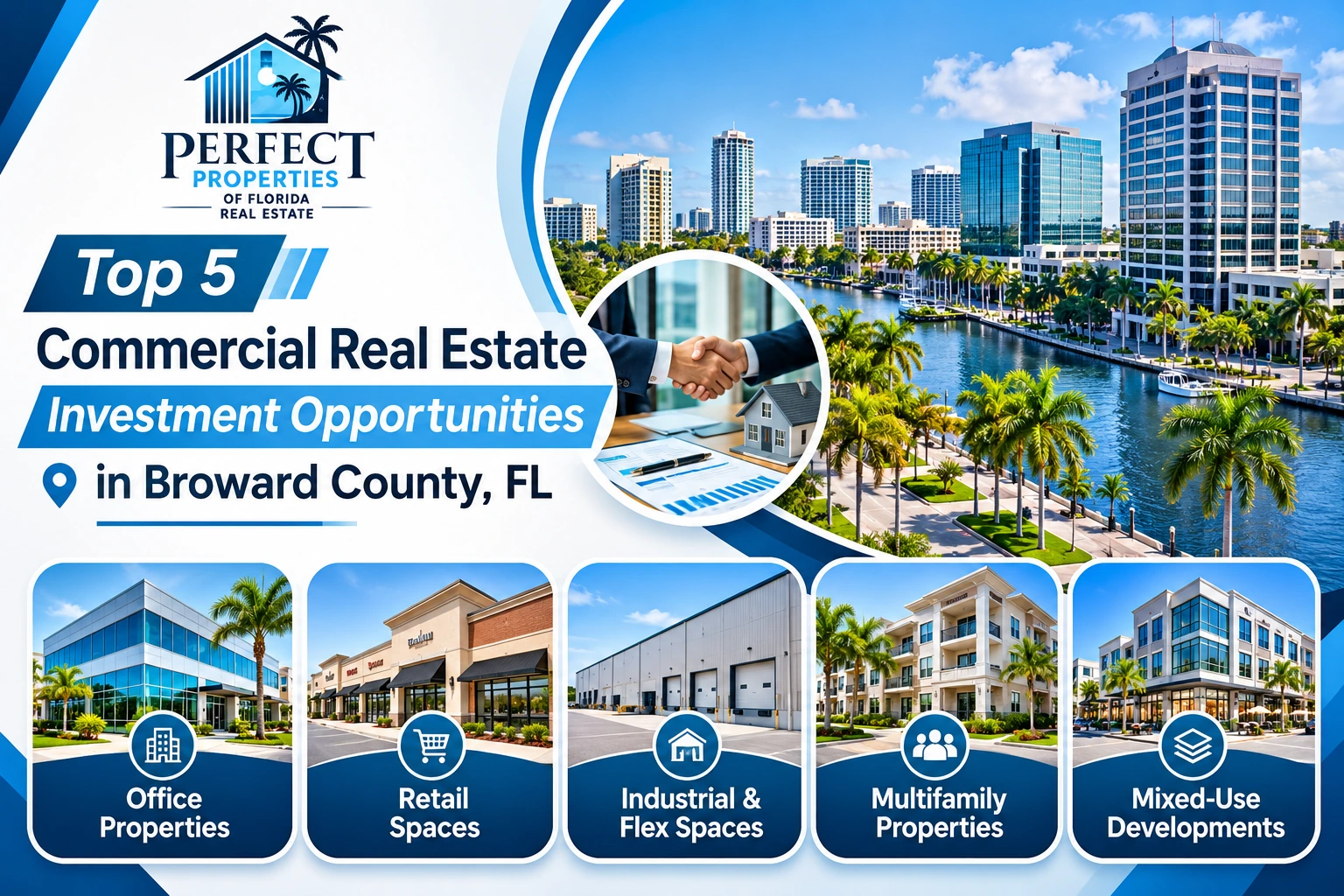
Broward County sits between Miami-Dade and Palm Beach counties and offers several kinds of commercial property, each with its own supply, demand, and risk. Commercial real estate investment in Broward County can include industrial buildings, retail centers, apartment buildings, offices, and mixed-use sites, depending on a buyer’s capital, goals, and appetite for management work.
This guide is for commercial property investors, from first-time buyers to out-of-state owners expanding into South Florida. It covers five commercial property opportunities to investigate, useful Broward locations, how to compare rental income, what to check before buying, and the risks to plan for. These are opportunities to research, not guaranteed returns.
Understanding the Commercial Real Estate Market in Broward County
Broward County deserves a spot on an investor’s research list for practical reasons. It sits between Miami-Dade and Palm Beach counties. Fort Lauderdale-Hollywood International Airport and Port Everglades support logistics and business activity. Established districts such as Las Olas Boulevard, Federal Highway, and Flagler Village give investors a range of Broward County commercial properties to study.
Recent sales data show an active but uneven market. MIAMI REALTORS reported that Broward commercial sales rose 27% to $5.5 billion in 2025, according to its 2025 year-end report. In the first half of 2026, Broward led in commercial sales volume, up about 7%, while South Florida overall fell 13% to $5.42 billion, per MIAMI REALTORS’ mid-year report.
Property types are not moving together. 2026 brokerage reports describe steady retail occupancy, rising industrial vacancy after new deliveries, higher office asking rents alongside high vacancy, and strong multifamily absorption. That is why Florida commercial property market trends should be read by asset class and submarket, not as one countywide story. For ongoing local real estate market insights, review Perfect Properties of Florida’s market reports.
Top 5 Commercial Real Estate Investment Opportunities
These five commercial investment properties are starting points for research. Suitability depends on acquisition price, property condition, financing, tenants, and your strategy. The figures below come from different firms that use different market boundaries and samples, so do not compare them as if they were measured the same way.
1. Multifamily Rental Properties
Apartment buildings with several rental units can appeal to investors who want recurring rental income. Because rent comes from many tenants, one vacancy usually matters less than it would in a single-tenant building. Investors still need to study occupancy, rental demand, lease turnover, management costs, maintenance, and capital improvements. Multifamily here means an income-producing building with multiple rental units, not an individual residential condo.
Supply matters. In its Q3 2026 report, Matthews showed Fort Lauderdale-area vacancy of 5.0%, slightly looser than a year earlier, with 495 units absorbed in the quarter versus 111 a year earlier. Cushman & Wakefield’s Q1 2026 report said units under construction had fallen close to 6,000, the lowest in Broward since 2020. Less new supply can help existing owners, but new competing communities can still affect rents.
Investors often research Fort Lauderdale, Pompano Beach, Plantation, Sunrise, and Hollywood. Matthews found Pompano Beach/Coral Springs the tightest submarket at 4.2% vacancy in Q3 2026. Remember that gross rental income is not profit. Net operating income is what remains after operating expenses, and no building produces positive cash flow automatically.
2. Industrial Warehouses and Flex Spaces
Industrial buildings support logistics, distribution, storage, light manufacturing, and business operations. Investors compare warehouses, small-bay industrial properties and flex space, along with loading docks, ceiling heights, truck access, parking and proximity to highways, airports and Port Everglades. Pompano Beach, Miramar, Davie and the Fort Lauderdale airport corridor are common places to look.
Current data shows why a closer look helps. CBRE’s Q3 2026 report put Broward industrial vacancy at 6.9%, with the rise tied to three new buildings that delivered vacant in Coral Springs and Southeast Broward. The same report showed 158,830 square feet of positive net absorption so far in 2026, after roughly 750,000 square feet of occupied space was lost between Q3 2025 and Q1 2026. CBRE’s Q2 2026 report put average asking rent at $17.58 per square foot, up 6.9% year over year. Broward industrial figures Q3 2026 +2
Low vacancy does not automatically mean high returns. Lease length, tenant credit quality, building condition, and functional layout also matter, and a small-bay building can behave differently from a large distribution warehouse. Ask for data that matches the size of the building you are considering.
3. Retail Shopping Centers and Strip Malls
Neighborhood retail centers, strip malls, and multi-tenant shopping centers can generate rental income when tenants stay, and customers keep coming. Investors look at grocery-anchored centers, neighborhood plazas, service-oriented retail, restaurants and essential-service tenants, plus parking, visibility and accessibility. Coral Springs, Sunrise, Plantation and Pompano Beach are common places to start.
Cushman & Wakefield’s Q3 2026 Broward retail report showed vacancy holding at 4.1%, up 10 basis points from a year earlier, and an average asking rent of $37.03 per square foot, down 0.2% from the prior quarter. Asking rent is what landlords request, not what tenants pay, so verify rents in the actual leases. Many retail leases are triple net (NNN), where the tenant generally pays specified property expenses on top of base rent. Read each lease to see what is covered.
Tenant mix is critical. A center that depends on one major tenant carries concentration risk, because income can fall quickly if that anchor leaves. Review lease expiration dates, tenant payment history, and the variety of businesses. Not every corridor has strong foot traffic, so visit at different times of day.
4. Office Buildings and Medical Office Properties
Office investors can evaluate Class A and Class B buildings, professional office properties, multi-tenant buildings, and medical or healthcare suites. Parking, accessibility, amenities, tenant retention, and lease renewals all matter. Fort Lauderdale, Plantation, and Sunrise are areas to investigate.
Office is where asking rents and occupancy can tell different stories. Cushman & Wakefield’s Q3 2026 Broward office report showed average asking rent of $45.59 per square foot, up 7.1% year over year. The same report put Class A vacancy at 18.3% and Class B at 14.0%, and overall vacancy was still 30 basis points above a year earlier despite a quarterly decline. It is also expected vacancy to rise into 2027 as new and returning space reaches the market. Rising asking rents alone do not signal stronger demand.
For this kind of income-producing commercial property, review vacancy, tenant demand, operating expenses, and future leasing needs. Medical office buildings may involve specialized build-outs, so confirm what each tenant space requires.
5. Mixed-Use and Waterfront Commercial Properties
Mixed-use properties combine retail, offices, residential units, restaurants or other uses on one site. Waterfront options can include restaurant properties, marinas and boatyards, hospitality-related sites and commercial parcels with redevelopment potential. Fort Lauderdale’s Las Olas area, the New River and the Intracoastal Waterway are examples of locations where specialized characteristics matter.
Pricing can vary widely even within one submarket. For example, Cushman & Wakefield’s Q3 2026 office report listed the Las Olas Corridor at an average asking rent of $80.90 per square foot, far above the countywide office average cited earlier.
These properties require extra homework. Check zoning, permitted uses, dock rights, waterfront access, flood exposure, and redevelopment restrictions before assuming a use is allowed. Waterfront ownership does not automatically increase profitability, and not every mixed-use property can be redeveloped. This is a category where local zoning knowledge matters.
Looking for Commercial Investment Properties in Broward County?
Choosing the right commercial property requires more than finding an available listing. Investors should evaluate location, tenant demand, lease structures, property condition, and financial performance before making a decision. Perfect Properties of Florida can help you explore commercial property opportunities and assess properties that align with your investment objectives.
Explore Commercial Real Estate Services
Best Broward County Locations to Explore for Commercial Investments
These areas are starting points for researching commercial properties for investment in Broward County, not a ranking. Fort Lauderdale, for example, offers commercial real estate opportunities across office, retail, mixed-use, and waterfront property, including industrial space near I-595 and areas near Port Everglades.
| Location | Property opportunities to investigate |
| Fort Lauderdale | Office, retail, mixed-use and waterfront commercial properties |
| Pompano Beach | Industrial, retail and multifamily properties |
| Plantation | Office, retail and multifamily properties |
| Miramar | Industrial, logistics and commercial developments |
| Davie | Flex industrial, commercial and mixed-use properties |
| Sunrise | Retail, office and multifamily properties |
| Coral Springs | Neighborhood retail, office and multifamily properties |
| Tamarac | Neighborhood retail, professional office and multifamily properties |
Tamarac, northwest of Fort Lauderdale, is largely residential, so commercial investors there often study neighborhood retail, professional offices and multifamily properties that serve nearby households. Look closely at traffic counts, tenant mix, competing centers and local zoning. Compare asking prices with similar Broward properties, not only other Tamarac listings.
Choose a location based on property type, zoning, access, tenant demand, competing inventory, and acquisition cost. Without comparable sales and rental evidence, ranking cities by investment return would only be a guess. Perfect Properties of Florida’s Broward County community pages can help you explore specific areas.
How to Compare Commercial Investment Properties
Compare every property with the same numbers. Start with the purchase price and gross potential rental income. Subtract vacancy and credit loss to estimate income actually collected, then subtract operating expenses to reach net operating income (NOI). NOI is property income after operating expenses but before debt service and income taxes. Also estimate maintenance and capital expenditures, which may not appear in a seller’s operating statement.
The capitalization rate (cap rate) divides NOI by the purchase price or value. Cash-on-cash return is different. It divides annual pre-tax cash flow by the cash you actually invested, so it reflects your financing.
| Illustrative commercial property example | Amount |
| Purchase price | $1,000,000 |
| Annual rental income (collected) | $100,000 |
| Annual operating expenses | $40,000 |
| Net operating income | $60,000 |
| Illustrative cap rate | 6% |
Calculation: $100,000 − $40,000 = $60,000 NOI. $60,000 ÷ $1,000,000 × 100 = 6%. These are hypothetical figures, not an actual Broward County listing or market average.
The cap rate leaves out your financing costs, and it should never be the only test. Commercial property investment returns also depend on vacancy, lease terms, and capital needs, which one percentage cannot show. Use commercial property valuation methods together, and ask a broker or accountant to check your assumptions.
Important Factors to Check Before Buying Commercial Property
Buying commercial property in Broward County takes more than a good listing. This commercial property due diligence checklist covers the main items:
- Zoning and permitted use: confirm with the municipality that your intended use is allowed.
- Building condition: have a commercial property inspector review the roof, structure, and major systems.
- Existing leases: review terms, expiration dates, and tenant payment history.
- Taxes and insurance: get current tax records and insurance quotes before finalizing your numbers.
- Environmental assessment: an investigation of potential environmental conditions and contamination.
- Flood zone and drainage: check the address in the FEMA Flood Map Service Center.
- Parking and access: confirm customer, delivery, and truck access.
- Utility capacity: check that power, water, and data meet your needs.
- Permits and code compliance: look for open permits or violations.
- Financing and closing costs: include lender fees, reserves, and legal costs.
These checks matter most for waterfront, industrial, and older commercial properties, where flood exposure, deferred maintenance and past uses can change costs. The EPA’s All Appropriate Inquiries guidance explains the standard for environmental due diligence in many purchases, and municipal zoning records show what a site may be used for. This list is educational. An attorney, CPA, inspector, and environmental professional should review the details.
Common Risks of Commercial Real Estate Investment in Broward County
Every commercial property investment risk below can be planned for, but none can be eliminated:
- Extended vacancy periods
- Tenant defaults
- Unexpected repairs
- Insurance premium increases
- Interest rate and refinancing risk
- New competing developments
- Zoning and permitting restrictions
- Flood and storm exposure
- Changes in local rental demand
Practical examples help. A retail center that loses its anchor tenant may see foot traffic and co-tenant sales drop. A warehouse that needs a new roof or upgraded electrical service before a tenant can move in turns projected income into a capital project. The 2026 reports above show how conditions can shift: industrial vacancy rose after new deliveries, and office vacancy is expected to rise into 2027.
Realistic projections that include vacancy, repairs, insurance, and refinancing assumptions, plus careful due diligence, can reduce avoidable surprises.
How Perfect Properties of Florida Can Help Commercial Property Investors
Perfect Properties of Florida is a South Florida brokerage whose commercial real estate services in Fort Lauderdale support buyers, sellers, landlords, and investors. As a commercial real estate broker in Fort Lauderdale, its team can help with:
- Commercial buyer representation and property sourcing
- Comparable sales and cap-rate analysis
- Commercial negotiations
- Lease structure and zoning considerations
- Seller representation
- Off-market sourcing and 1031 exchange assistance (confirm tax questions with a CPA)
- Investment property guidance
These services help you evaluate suitable commercial investment properties before you decide to buy. Every property performs differently, so the goal is informed evaluation, not promised results. If you are narrowing a search, speak with a local real estate professional about your investment requirements.
Frequently Asked Questions
Is Broward County a good place to invest in commercial real estate?
It can be worth researching. Broward sits between Miami-Dade and Palm Beach counties, has airport and port access, and includes industrial, retail, office, and multifamily markets. Those markets perform differently, so property-specific research matters more than any countywide label. Review local vacancy, rents, and tenant demand before buying.
What types of commercial real estate are best for investment?
Common commercial investment properties include industrial warehouses, retail shopping centers, multifamily properties, office buildings, and mixed-use developments. The best fit depends on your capital, risk tolerance, management capacity, and income goals. Each category has different tenants, lease structures, and expenses.
How much money do you need to buy commercial property in Florida?
It depends on the price, financing terms, and property. Budget for the down payment, financing costs, inspections, environmental and other due diligence, closing costs, and working capital for repairs and vacancies. Lenders set terms based on the property, borrower, and deal structure, so ask lenders for current requirements.
What is a good cap rate for commercial real estate?
There is no universal good cap rate. The cap rate is net operating income divided by purchase price or value, and it varies by property type, location, condition, and lease strength. Compare it with similar properties, and combine it with cash flow, vacancy, and capital-needs analysis.
What should investors check before purchasing commercial property in Broward County?
Check zoning and permitted use, building inspections, leases, environmental assessments, flood exposure, taxes, insurance, and operating expenses. Review rent rolls and tenant payment history. Use an attorney, inspector, and CPA for specialized questions.
Which Broward County areas should investors consider for commercial properties?
Common research areas include Fort Lauderdale, Pompano Beach, Plantation, Miramar, Davie, Sunrise, Coral Springs, and Tamarac. The best location depends on the property type, tenant demand, transportation access, and acquisition cost. Compare submarkets using current vacancy, rent, and sales evidence.
Conclusion
Commercial real estate investment in Broward County offers several paths: multifamily rental properties, industrial warehouses and flex space, retail shopping centers, office and medical office buildings, and mixed-use and waterfront properties. The right choice depends on your financial objectives, tenant demand, location, purchase price, operating expenses, and due diligence. Commercial property investors who compare current market evidence, run conservative numbers, and verify every property detail are better prepared to decide with confidence. A local commercial real estate professional can help you evaluate your options.
Start Exploring Commercial Real Estate Opportunities in Broward County
Whether you’re considering an industrial warehouse, retail center, multifamily property, or commercial office building, finding the right investment starts with understanding your goals and the local market. Contact Perfect Properties of Florida to discuss your commercial real estate requirements and explore suitable opportunities in Broward County.
(305) 790-0199 | jgaylis@perfectpropertiesfl.com
Speak With a Commercial Real Estate Professional